
Quick answer
Burnout is a response to chronic workplace stress: exhaustion, distance or cynicism about the job, and feeling less effective. It isn't classified as a medical condition. Much of what healthcare workers call burnout is closer to moral injury, the distress of knowing what a patient needs and being unable to provide it. When symptoms follow you into time off, your relationships, your sleep and how you see yourself, it's worth an evaluation for depression, anxiety or trauma, which respond to treatment.
Key takeaways
- Burnout is a response to chronic workplace stress, marked by exhaustion, detachment and a reduced sense of accomplishment.
- Much of what healthcare workers call burnout is closer to moral injury: knowing what a patient needs and being unable to provide it.
- When distress follows you into time off, your relationships, your sleep and how you see yourself, it's worth an evaluation.
- Depression and anxiety respond to treatment even when the circumstances that produced them continue.
Healthcare worker burnout is discussed frequently and defined imprecisely. It is commonly treated as exhaustion that resolves with rest, which is why the interventions offered — wellness modules, resilience training, gratitude exercises — so often land badly.
The mismatch is not accidental. Much of what is labeled burnout in healthcare is a different phenomenon, and naming it accurately changes what helps.
What Burnout Technically Describes
The occupational syndrome has three recognized components.
Emotional exhaustion. Depletion that rest does not restore.
Depersonalization. Detachment from patients, sometimes expressed as cynicism, which is frequently the most distressing component because it conflicts with why the person entered the field.
Reduced sense of personal accomplishment. The sense that the work no longer matters or that one is no longer effective at it.
Burnout is a response to chronic workplace stress. It is situational rather than a psychiatric diagnosis.
Where Moral Injury Fits
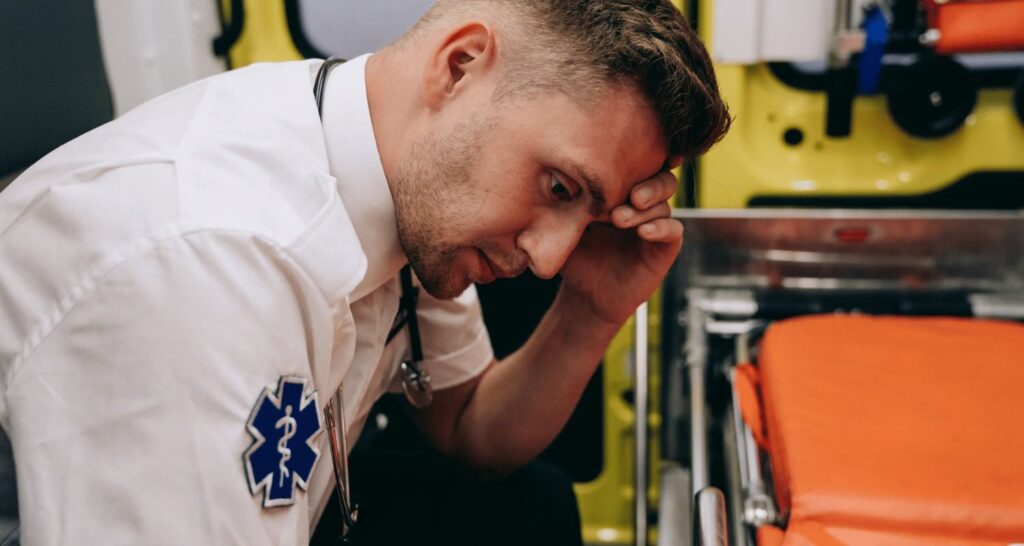
The concept that frequently describes healthcare experience more accurately is moral injury — the distress arising from being unable to act in accordance with one’s own values because of constraints beyond one’s control.
The distinction matters practically. Burnout implies depletion, and the implied remedy is rest and recovery. Moral injury implies a conflict between what a clinician believes is right and what circumstances permit, and rest does not touch it.
The clinical situations are recognizable: knowing what a patient needs and being unable to provide it because of coverage, staffing, or time. Discharging someone to a situation that will not hold. Choosing between patients because there is not enough of you. Documenting rather than sitting with someone who is frightened.
When a person in that situation is offered resilience training, the message received is that the problem is their capacity rather than the conditions. That is why wellness programming so often produces resentment rather than relief.
Is it this or that?
Burnout, moral injury, or depression?
| Burnout | Moral injury | Depression | |
|---|---|---|---|
| What it is | A response to chronic workplace stress that hasn't been managed: exhaustion, mental distance or cynicism about the job, and feeling less effective. | Distress from being unable to act on your own values because of constraints you don't control, like staffing, coverage or time. | A treatable mood condition: low mood or loss of interest most of the day, nearly every day, for at least 2 weeks. |
| Where it shows up | At work. It describes the work setting, not other areas of life. | Around the gap between what a patient needs and what the system allows. | Across life: work, relationships, interests, sleep, appetite and how you see yourself. |
| Does rest help? | Often, with genuine time away. | Not much. Rest doesn't change the conflict between what you believe is right and what circumstances permit. | Not reliably. Symptoms tend to continue on days off and on vacation. |
| What tends to help | Real recovery time and changes to the demands that drive it. | Naming it accurately, and changes to the conditions that cause it. | An evaluation and treatment, which can work even while the job continues. |
Burnout
- What it is
- A response to chronic workplace stress that hasn't been managed: exhaustion, mental distance or cynicism about the job, and feeling less effective.
- Where it shows up
- At work. It describes the work setting, not other areas of life.
- Does rest help?
- Often, with genuine time away.
- What tends to help
- Real recovery time and changes to the demands that drive it.
Moral injury
- What it is
- Distress from being unable to act on your own values because of constraints you don't control, like staffing, coverage or time.
- Where it shows up
- Around the gap between what a patient needs and what the system allows.
- Does rest help?
- Not much. Rest doesn't change the conflict between what you believe is right and what circumstances permit.
- What tends to help
- Naming it accurately, and changes to the conditions that cause it.
Depression
- What it is
- A treatable mood condition: low mood or loss of interest most of the day, nearly every day, for at least 2 weeks.
- Where it shows up
- Across life: work, relationships, interests, sleep, appetite and how you see yourself.
- Does rest help?
- Not reliably. Symptoms tend to continue on days off and on vacation.
- What tends to help
- An evaluation and treatment, which can work even while the job continues.
General information, not a diagnosis. They often overlap. Definitions from the World Health Organization (burnout) and the National Institute of Mental Health (depression).
What Is Actually Clinical
Burnout and moral injury are situational. They also frequently co-occur with conditions that are diagnosable and treatable, and the two get conflated in ways that delay care.
Depression. Persistent low mood, anhedonia, sleep and appetite change, and hopelessness extending beyond work into other domains. Burnout that has generalized past the workplace warrants evaluation for depression.
Anxiety disorders. Persistent worry, physical symptoms, and anticipatory dread that continue on days off.
Trauma responses. Healthcare work involves repeated exposure to death, injury, and acute distress. Intrusive memories, hypervigilance, avoidance, and nightmares are trauma symptoms and warrant trauma-focused assessment rather than being absorbed as part of the job.
Substance use. Alcohol use that has escalated to manage the aftermath of shifts is common and under-reported.
Elevated risk. Research has found suicide rates among nurses are elevated relative to the general population. This is not a reason for alarm in any individual case, and it is a reason the profession should not treat distress in clinicians as ordinary.
The distinguishing question is domain. Burnout is generally tied to work and improves with genuine time away. When symptoms persist on vacation, extend into relationships and interests, and involve changes in sleep, appetite, and self-perception, that points toward a condition rather than a situation.
Myth or fact? Burnout and getting care
Choose an answer for each to see the explanation. Nothing is saved.
1Burnout is an official medical diagnosis.
Myth. The World Health Organization describes burnout as an occupational phenomenon, not a medical condition. That's why it's worth checking whether something diagnosable and treatable, like depression or anxiety, is going on alongside it.
2Every licensing board asks the same mental health questions.
Myth. Questions vary by state and change over time. Some ask only about current impairment; others ask more broadly. A study of state medical licensure applications found the questions shaped how reluctant physicians were to seek care. Read your own board's current wording rather than assuming the worst.
3Burnout that has spread past work, into weekends, relationships and sleep, is worth an evaluation for depression.
Fact. Burnout is generally tied to work and improves with real time away. Low mood or loss of interest that lasts most days for 2 weeks or more and reaches every part of life points toward a condition, not just a situation.
Why Healthcare Workers Do Not Seek Care

Licensure concern. Fear that seeking treatment will affect licensing or credentialing. Many boards have revised questions to focus on current impairment rather than history of treatment, but requirements vary and change. Anyone with this concern should review their own board’s current language rather than assume the worst — and the assumption itself keeps people out of care.
Confidentiality within a small community. Reluctance to be treated by colleagues or within the same system. Telehealth with an unaffiliated practice addresses this directly.
Self-treatment. Informal prescribing, self-diagnosis, and managing without evaluation. This is common, and it skips the evaluation that formal care provides.
The expectation of endurance. A professional culture in which needing help reads as weakness.
Scheduling. Shift work and clinical hours conflict with typical appointment availability.
What Actually Helps
Distinguishing situation from condition, and treating what is treatable. Depression and anxiety respond to treatment regardless of whether the circumstances producing them persist — the assumption that treatment cannot work while the job continues is common and inaccurate.
Where trauma exposure is central, trauma-focused treatment rather than general stress management. Where sleep is disrupted by shift work, addressing it directly. And honest evaluation of alcohol use.
For moral injury specifically, what helps most is naming it accurately. Recognizing the distress as a response to constraint rather than as a personal deficiency changes what the person concludes about themselves, and that reframe is itself clinically meaningful.
Frequently Asked Questions
What is the difference between burnout and depression?
Burnout is an occupational syndrome tied to workplace stress — exhaustion, detachment, and reduced sense of accomplishment — that typically improves with genuine time away and is generally specific to work. Depression is a clinical condition involving persistent mood change, anhedonia, and neurovegetative symptoms that extend across all domains and do not resolve with rest. When burnout has generalized beyond work, evaluation for depression is warranted.
What is moral injury in healthcare?
It describes distress arising from being unable to act according to your own values because of constraints beyond your control — knowing what a patient needs and being unable to provide it because of staffing, coverage, or time. It differs from burnout in that rest does not address it, which is why wellness programming frequently produces resentment rather than relief in clinicians experiencing it.
Will seeking psychiatric treatment affect my professional license?
Many licensing and credentialing bodies have revised their questions to focus on current impairment affecting practice rather than on history of treatment. Requirements vary by state, profession, and organization, and they change. Reviewing your own board’s current language is worth doing rather than assuming, since the assumption that treatment is reportable keeps a great many clinicians out of care unnecessarily.
Why do healthcare workers avoid getting mental health care?
Common reasons include concern about licensure and credentialing, reluctance to be treated within a system where colleagues might have access, a professional culture that treats needing help as weakness, scheduling conflicts with clinical hours, and a tendency toward self-treatment. Telehealth with an unaffiliated practice addresses several of these directly.
If distress has followed you home, persisted through time off, and changed how you sleep and how you see yourself, that has moved beyond a situational response and warrants evaluation.
This article is for general educational purposes only. It does not constitute medical advice, does not establish a provider-patient relationship, and is not a substitute for individual evaluation, diagnosis, or treatment by a qualified clinician. If you’re in crisis or thinking about harming yourself, call or text 988 (Suicide & Crisis Lifeline), any time, day or night. In an emergency, call 911 or go to the nearest emergency room.
The science: how we checked this
Sources
- World Health Organization: Burn-out an "occupational phenomenon"
- National Institute of Mental Health: Depression
- Moral Injury in Health Care: A Unified Definition and its Relationship to Burnout. Federal Practitioner, 2024
- A Rescoping Investigation of Burnout vs Moral Injury in Urology and the Broader Health Care Field. Urology Practice, 2025
- Dyrbye LN, et al. Medical Licensure Questions and Physician Reluctance to Seek Care for Mental Health Conditions. Mayo Clinic Proceedings, 2017
How we checked this
- Written in our own words from the sources above.
- What burnout is, its three dimensions, that it applies to the work setting and isn't classified as a medical condition: World Health Organization.
- What moral injury is, and why it goes beyond exhaustion: the Federal Practitioner (2024) and Urology Practice (2025) reviews.
- What depression is and the 2-week timeframe: NIMH.
- Licensing questions varying by state and affecting reluctance to seek care: Mayo Clinic Proceedings (2017).
- Whether rest helps, and what tends to help, sum up this article's own explanation.
Live in New Jersey? Start your intake packet.


