
Quick answer
Sadness is a normal response to loss or disappointment. It comes in waves, eases with good moments, and usually fades as life changes. Depression is a health condition: low mood or loss of interest most of the day, nearly every day, for at least two weeks, along with changes in sleep, energy, concentration and how you see yourself, that make daily life harder. If you're not sure which it is, that uncertainty is a good reason to get an evaluation rather than wait.
Key takeaways
- Sadness and depression share some features, but they differ in what's actually happening, not just in degree.
- Sadness usually lifts in response to good moments, while depression tends not to respond to positive events.
- Depression can affect concentration, sleep, energy and how you see yourself, and it can be present without obvious sadness.
- If you're unsure whether it's sadness or depression, that uncertainty is a reason to get an evaluation rather than wait.
Sadness and depression share surface features — low mood, reduced energy, withdrawal from normal activity. They are not the same thing, and treating them as equivalent has costs in both directions. People with depression tell themselves they are just sad and delay getting care. People experiencing ordinary sadness are sometimes told they have a disorder. A thorough psychiatric evaluation in New Jersey exists in part to make this distinction accurately.
The difference is not a matter of degree. It is a difference in what is happening.
What Sadness Is
Sadness is a normal, adaptive response to loss, disappointment, or difficulty. It is proportional to a cause the person can usually identify. It comes in waves rather than as a constant state. And it remains responsive to circumstance — a good conversation, an unexpected kindness, a distraction that works. The capacity for pleasure stays intact even when it is not being accessed.
Sadness also tends to resolve. Not on a fixed schedule and not linearly, but the trajectory bends toward recovery as circumstances change or as the person adapts to them.
Most importantly, sadness does not typically alter a person’s fundamental sense of themselves. Someone who is sad still knows they are capable, still recognizes their relationships as real, still expects the feeling to end.
Myth or fact? Sadness and depression
Choose an answer for each to see the explanation. Nothing is saved.
1Feeling low after a loss or a hard event usually means you're depressed.
Myth. Grief, disappointment and discouragement after a hard event usually aren't a disorder. They tend to come in waves tied to reminders, fade over time, and don't seriously get in the way of daily life for long.
2You can be depressed without feeling sad.
Fact. Depression can show up mainly as loss of interest or pleasure, irritability, numbness, tiredness or trouble concentrating. Some people describe feeling nothing rather than feeling low.
3Depression is just a stronger version of sadness.
Myth. It's a different thing, not just more of the same. Depression changes mood, thinking, energy, sleep, appetite and how you see yourself, and it often doesn't lift even when something good happens.
What Depression Is
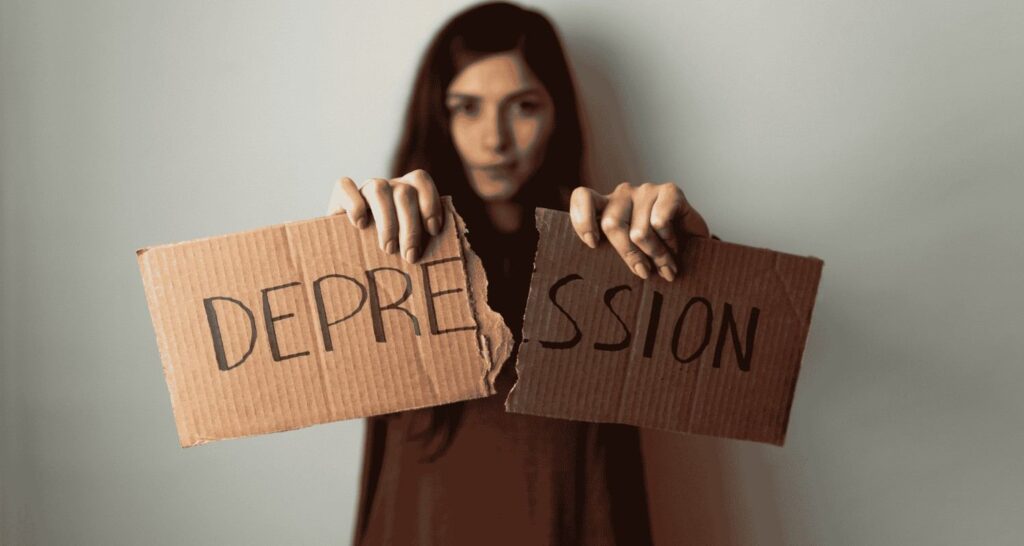
Depression is a clinical condition involving persistent changes in mood, cognition, energy, sleep, appetite, and self-perception that last at least two weeks and produce meaningful functional impairment.
The distinguishing features are specific. Mood is persistently low rather than fluctuating. Anhedonia — the loss of interest or pleasure in things that used to be rewarding — is present and does not lift when circumstances briefly improve. Cognition changes: concentration becomes difficult, decisions become disproportionately hard, memory feels unreliable. Sleep and appetite shift in either direction. Energy drops in a way that rest does not correct.
And self-perception changes. Depression produces a distorted view of one’s own worth, past, and future — not as an opinion the person holds, but as something that feels like accurate perception. This is one reason depression is dangerous. It compromises the very faculty a person would use to evaluate whether they need help.
Four Questions That Distinguish Them
Does it lift? Sadness responds to positive input, even briefly. Depression tends not to. When someone reports that nothing helps — not good news, not time with people they love, not activities that used to work — that is clinically significant.
How long has it lasted? Two weeks of persistent symptoms is the diagnostic threshold, though many people who eventually seek care have been experiencing symptoms far longer.
Is functioning affected? Sadness is painful but usually compatible with working, maintaining relationships, and managing daily life. Depression erodes those capacities.
Has self-perception changed? Sadness about a situation is different from a settled belief that one is worthless, a burden, or beyond help. The latter is a symptom, not an assessment.
Is it this or that?
Sadness, or depression?
| Sadness | Depression | |
|---|---|---|
| Does it lift? | Eases, at least for a while, with good news, time with people you love or a distraction. | Often doesn't lift, even briefly. Things you used to enjoy may stop feeling rewarding. |
| How long it lasts | Comes in waves and usually fades as circumstances change or you adjust. | Symptoms most of the day, nearly every day, for at least two weeks. |
| Daily life | Painful, but you can usually keep working, stay connected and manage day to day. | Makes it harder to work, keep up relationships and handle daily tasks. |
| How you see yourself | You still see yourself as capable and expect the feeling to end. | Feelings of worthlessness, guilt or hopelessness can start to feel like the truth. |
Sadness
- Does it lift?
- Eases, at least for a while, with good news, time with people you love or a distraction.
- How long it lasts
- Comes in waves and usually fades as circumstances change or you adjust.
- Daily life
- Painful, but you can usually keep working, stay connected and manage day to day.
- How you see yourself
- You still see yourself as capable and expect the feeling to end.
Depression
- Does it lift?
- Often doesn't lift, even briefly. Things you used to enjoy may stop feeling rewarding.
- How long it lasts
- Symptoms most of the day, nearly every day, for at least two weeks.
- Daily life
- Makes it harder to work, keep up relationships and handle daily tasks.
- How you see yourself
- Feelings of worthlessness, guilt or hopelessness can start to feel like the truth.
General information, not a diagnosis. Based on the National Institute of Mental Health and the Merck Manual.
Why the Distinction Matters Clinically

Getting this wrong is costly in both directions.
When depression is misread as sadness, people wait. They wait for circumstances to change, for time to pass, for themselves to snap out of it. The delay between symptom onset and treatment is frequently measured in years. An untreated episode of depression typically lasts about six months, sometimes two years or more, and episodes tend to come back over a lifetime.
When ordinary grief or situational sadness is treated as a disorder, the cost is different but real — unnecessary medication, a diagnostic label that shapes self-understanding, and a missed opportunity to address the actual circumstance producing the distress.
This is why appointment length matters. Distinguishing depression from sadness requires history: what the last several months have looked like, what has been tried, whether there have been prior episodes, what changed and when. For many adults, this careful history is what has been missing from previous care.
What Happens After the Distinction Is Made
If the picture is sadness or grief, the appropriate response is usually support, time, and attention to the circumstance rather than medication. That is a legitimate clinical outcome and should be stated clearly rather than treated as a failure to find something.
If the picture is depression, evidence-based options include psychotherapy — Cognitive Behavioral Therapy has strong evidence for depression — medication, or both. Moderate to severe depression generally responds better to combined treatment than to either component alone.
And when the picture is genuinely unclear, the honest answer is that it is unclear, and that watching the pattern over the next several weeks will produce more useful information than forcing a conclusion now.
Check your understanding
Three quick questions
1Which of these is one of the most useful signs that low mood may be depression?
Sadness usually responds to positive moments, even briefly. When nothing helps, not good news, not time with people you love, that's a sign worth taking seriously.
2If an evaluation shows the picture is sadness or grief, what's usually the right response?
For sadness or grief, the usual response is support, time and attention to the circumstance rather than medication. That's a legitimate outcome, not a failure to find something.
3You can't tell whether it's sadness or depression. What does this article suggest?
Uncertainty is itself a reason to have an evaluation rather than a reason to wait. Sometimes watching the pattern over several weeks gives the clearest answer.
Frequently Asked Questions
How do I know if I am depressed or just sad?
The most useful questions are whether the mood lifts in response to positive events, how long it has persisted, and whether your functioning and self-perception have changed. Sadness usually responds to circumstance and remains compatible with daily life. Depression tends to be unresponsive, lasts at least two weeks, and typically alters how you see yourself. If you are uncertain, that uncertainty is itself a reason to have an evaluation rather than a reason to wait.
Can you have depression without feeling sad?
Yes. This is common and frequently missed. Depression can present primarily as irritability, emotional numbness, physical fatigue, cognitive difficulty, or loss of interest without prominent sadness. Some people describe feeling nothing rather than feeling low. The absence of tearfulness does not rule out depression, and assuming that it does is one reason depression goes undiagnosed for years.
What happens at a first psychiatric appointment in NJ for depression?
A thorough first appointment gathers considerably more than a symptom checklist. It covers current symptoms, how long they have been present, functioning across work and relationships, medical history and current medications, family history, any previous treatment and how it went, and what life looked like before the symptoms started. That history is what allows an accurate diagnosis rather than a provisional one.
Does sadness ever turn into depression?
It can. Prolonged or overwhelming sadness — particularly following significant loss, sustained stress, or circumstances a person cannot change — can develop into a depressive episode in someone who is vulnerable to one. The transition is not always obvious from the inside. What tends to mark it is the loss of responsiveness: the point at which mood stops lifting even briefly.
If low mood has persisted for weeks, stopped responding to the things that used to help, or begun to change how you see yourself, that is worth evaluating properly rather than waiting to see whether it passes.
This article is for general educational purposes only. It does not constitute medical advice, does not establish a provider-patient relationship, and is not a substitute for individual evaluation, diagnosis, or treatment by a qualified clinician. If you’re in crisis or thinking about harming yourself, call or text 988 (Suicide & Crisis Lifeline), any time, day or night. In an emergency, call 911 or go to the nearest emergency room.
The science: how we checked this
Sources
How we checked this
- Written in our own words from the sources above.
- Depression being diagnosed from symptoms most of the day, nearly every day, for at least two weeks, with depressed mood or loss of interest, and its effect on daily activities: NIMH, Depression.
- Grief and discouragement after hard events usually not being a disorder, coming in waves and not interfering with functioning for long; loss of pleasure, irritability, guilt and trouble concentrating in depression: Merck Manual, Depression.
- Feelings of worthlessness, guilt or hopelessness as symptoms: NIMH, Depression.
- The quiz answers and the last myth card sum up this article's own explanation.
Live in New Jersey? Start your intake packet.