
Quick answer
Alcohol can ease tension for a few hours, but as it wears off the brain rebounds, and many people feel more restless and anxious than before they drank. It also breaks up sleep later in the night, and heavy drinking and depression tend to feed each other. If alcohol has become a regular way to cope, it's worth talking about with your provider. If you drink heavily and often, please don't stop suddenly on your own: alcohol withdrawal can be dangerous, so talk with a medical provider first.
Key takeaways
- Alcohol can briefly ease anxiety, but as it wears off the brain rebounds, often leaving anxiety stronger than before.
- Alcohol helps you fall asleep but disrupts sleep later in the night, which can worsen anxiety and depression.
- Alcohol and depression feed each other, and regular heavy drinking is a significant risk factor for depression.
- Alcohol can interact with psychiatric medications, so it's worth discussing openly with your provider.
Alcohol is among the most commonly used substances for managing anxiety, stress, and low mood. The relief it provides is real — and the way it compounds anxiety and depression over time is equally real. Understanding the mechanism behind both is important for making informed decisions about use.
Why Alcohol Feels Like It Helps
Alcohol is a CNS depressant that works primarily by enhancing GABA activity — the inhibitory neurotransmitter that reduces nervous system activation — and reducing glutamate activity, which is excitatory. The net effect is a dampening of anxious arousal, much like the calming that GABA provides naturally. The tension reduces. Social situations feel more manageable. The mind quiets somewhat. This is the pharmacological basis of alcohol’s anxiety-reducing effect in the short term.
The Rebound Effect
The problem is what happens next. As alcohol is metabolized — typically several hours after drinking — the same neurotransmitter systems that were suppressed rebound. The anxiety that returns is frequently more intense than the anxiety that preceded the drink. This rebound effect, sometimes called the ‘hangxiety’ that many people recognize, is not incidental. It is the predictable physiological consequence of using alcohol to suppress a system that then rebounds when the suppression is removed.
Is it this or that?
Tonight's relief, or tomorrow's cost?
| While drinking | As it wears off, and over time | |
|---|---|---|
| Anxiety | Tension eases and you feel calmer. | The brain, which has adjusted to the alcohol, rebounds. Many people feel more restless and anxious than before they drank. |
| Sleep | You may fall asleep faster. | Sleep gets lighter and more broken, especially in the second half of the night, with less REM (dreaming) sleep. |
| Mood | A short sense of relief. | Over time, heavy drinking can make anxiety and depression worse, and low mood can lead to more drinking. |
While drinking
- Anxiety
- Tension eases and you feel calmer.
- Sleep
- You may fall asleep faster.
- Mood
- A short sense of relief.
As it wears off, and over time
- Anxiety
- The brain, which has adjusted to the alcohol, rebounds. Many people feel more restless and anxious than before they drank.
- Sleep
- Sleep gets lighter and more broken, especially in the second half of the night, with less REM (dreaming) sleep.
- Mood
- Over time, heavy drinking can make anxiety and depression worse, and low mood can lead to more drinking.
General information, not medical advice. Sources: the National Institute on Alcohol Abuse and Alcoholism and the Sleep Foundation.
Alcohol and Sleep
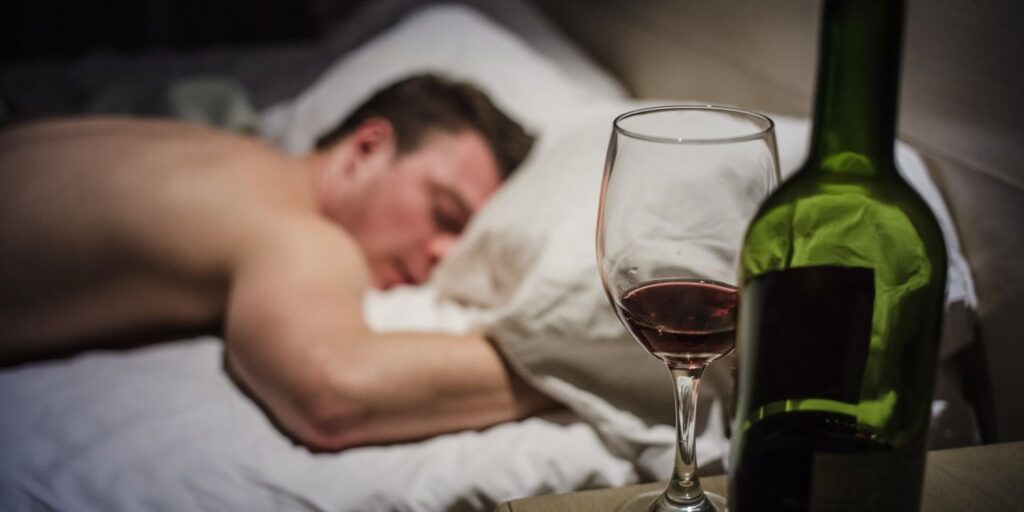
Alcohol and sleep have a similarly complicated relationship. Alcohol is sedating — it reduces the time it takes to fall asleep — which leads many people to use it as a sleep aid. But alcohol significantly disrupts sleep architecture, suppressing REM sleep and producing fragmented, non-restorative sleep in the second half of the night. People who drink to sleep often wake earlier, feel less rested despite sleeping, and find that the sleep debt accumulates. Since disrupted sleep is itself a significant driver of both anxiety and depression, the sleep disruption that alcohol produces becomes one of the mechanisms through which regular drinking worsens mental health over time.
The Bidirectional Relationship With Depression
The relationship between alcohol and depression is bidirectional and well-documented. Depression is a significant risk factor for heavy alcohol use — people drink to manage low mood and anhedonia. And regular heavy alcohol use is a significant risk factor for depression — both through its direct neurobiological effects and through the secondary consequences that accumulate over time. The National Institute of Mental Health notes that many people with substance use disorders also have depression, anxiety or other mental health conditions, and that integrated care treats both together.
Myth or fact? Alcohol, mood and medication
Choose an answer for each to see the explanation. Nothing is saved.
1Anxiety the day after drinking can come from the alcohol itself.
Fact. Even in people without an anxiety disorder, anxiety can show up after a single episode of heavy drinking (often called "hangxiety"), and it can build between drinking episodes.
2Alcohol and antidepressants don't really interact.
Myth. The National Institute on Alcohol Abuse and Alcoholism lists antidepressants among the medications that interact with alcohol. Possible effects include drowsiness, dizziness and stronger feelings of depression or hopelessness. Ask your prescriber or pharmacist about your own medications.
3If I drink heavily every day, the safest thing is to stop all at once on my own.
Myth. Alcohol withdrawal can range from uncomfortable to life-threatening, so stopping heavy drinking should be done with medical guidance. Call 911 or go to the nearest emergency room for seizures, fever, severe confusion, hallucinations or an irregular heartbeat. At ANK, we see patients with substance use alongside a psychiatric condition when outpatient care is safe; we don't offer detox.
Alcohol and Psychiatric Medications

For people taking psychiatric medications, alcohol introduces additional considerations. Alcohol interacts with many psychiatric medications in ways that range from reducing their effectiveness to producing potentially dangerous combinations. SSRIs and SNRIs can interact with alcohol to cause drowsiness and dizziness and to deepen feelings of depression or hopelessness. Some medications have more significant interactions. Understanding how psychiatric medication works — and how alcohol interacts with specific medications — is an important part of medication management that deserves explicit discussion with your provider.
What This Means Clinically
Regular alcohol use is worth including in a clinical conversation about mental health, particularly when anxiety or depression is present. Not because alcohol use is inherently a moral failure, but because it is often playing a role in maintaining or worsening the very conditions it is being used to manage — and because effective psychiatric treatment that addresses anxiety or depression directly is a more reliable path to the relief alcohol has been providing temporarily.
Frequently Asked Questions
Why does alcohol make anxiety worse the next day?
Because alcohol boosts the calming GABA system and reduces glutamate activity, and the brain adjusts to it. When alcohol is metabolized, these systems rebound — often to a state more activated than before drinking. This rebound produces the increased anxiety, irritability, and restlessness that characterize hangxiety.
Can I drink alcohol if I have anxiety?
There is no universal prohibition, but the pattern of using alcohol to manage anxiety is worth examining honestly. If you find yourself drinking to take the edge off anxiety regularly, that pattern deserves clinical attention — both because it is likely worsening the anxiety over time and because more effective and sustainable approaches to anxiety management exist.
Does alcohol cause depression?
Regular heavy alcohol use is a significant risk factor for depression, both through direct effects on the brain and through secondary consequences including disrupted sleep, relationship strain, and withdrawal effects. The relationship is bidirectional: depression increases alcohol use, and alcohol use worsens depression.
Is it safe to drink on antidepressants?
Alcohol interacts with many psychiatric medications in ways that range from modest to clinically significant. With SSRIs, concerns include drowsiness, dizziness and stronger feelings of depression or hopelessness. With some other medications, the interactions are more serious. This is worth discussing directly with your prescriber rather than assuming it is fine or assuming it is categorically dangerous — the answer depends on the specific medications involved.
If alcohol has become a regular part of how you manage anxiety, stress, or low mood — and if you have noticed that it takes more to get the same relief, or that the next day is harder — those observations are worth bringing to a clinical conversation.
The science: how we checked this
Sources
- National Institute on Alcohol Abuse and Alcoholism: Hangovers
- Sleep Foundation: Alcohol and Sleep
- National Institute on Alcohol Abuse and Alcoholism: Mental Health Issues: Alcohol Use Disorder and Common Co-occurring Conditions
- National Institute on Alcohol Abuse and Alcoholism: Harmful Interactions: Mixing Alcohol With Medicines
- MedlinePlus: Alcohol withdrawal
How we checked this
- Feeling calmer while drinking and more restless and anxious afterward, and falling asleep faster but sleeping in a broken way: NIAAA, Hangovers.
- Less REM sleep and broken sleep in the second half of the night: Sleep Foundation.
- Anxiety after a single heavy drinking episode, and heavy drinking worsening anxiety and mood over time: NIAAA's core resource on alcohol and co-occurring conditions.
- Antidepressants and alcohol: NIAAA's list of harmful interactions.
- Alcohol withdrawal being potentially life-threatening, and when to get emergency help: MedlinePlus.
- Seeing patients with substance use alongside a psychiatric condition when outpatient care is safe, and not offering detox, is ANK's own policy.
- Written in our own words from the sources above.