
Quick answer
What you eat does seem to matter for mental health, but it's one part of the picture, not a cure. The Mediterranean eating pattern has the most research support, and diets high in ultra-processed food are linked with higher rates of depression and anxiety. For significant depression or an anxiety disorder, medication and therapy have much stronger evidence, so diet works best alongside treatment, not in place of it.
Key takeaways
- The Mediterranean eating pattern (vegetables, legumes, whole grains, fish and olive oil) has the most research support for mental health.
- Eating more ultra-processed food is linked with higher rates of depression and anxiety. These studies show a link, not proof that the food causes the symptoms.
- Supplements like omega-3s are less proven than they're often made to sound; ask your provider before starting one.
- Diet works best as one part of your care, alongside treatment, not as a replacement for it.
The relationship between nutrition and mental health is more substantial than it once was — and more nuanced than wellness marketing often suggests. This is a developing but genuinely meaningful area of research, and understanding what the evidence actually supports matters for making good decisions about mental health care.
Why Nutrition Affects the Brain
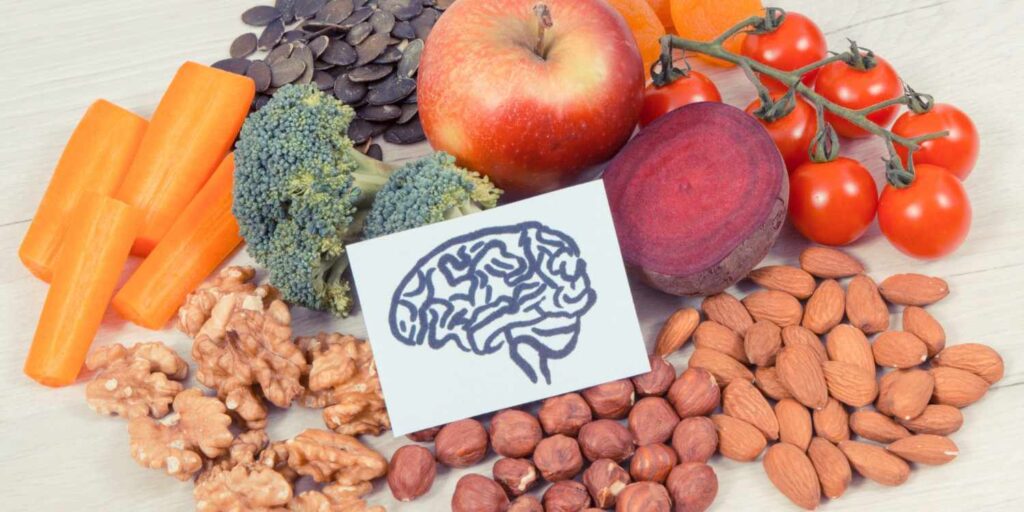
The brain is a metabolically active organ with specific nutritional requirements. It requires glucose for energy, but it also depends on fatty acids, amino acids, vitamins, minerals, and trace elements for neurotransmitter synthesis, neuroplasticity, inflammatory regulation, and the structural integrity of neurons and myelin.
Several specific nutrients have particular significance for mental health. Omega-3 fatty acids — found in fatty fish, walnuts, and flaxseed — are components of neuronal cell membranes and have anti-inflammatory properties. Low omega-3 levels have been associated with depression and anxiety in multiple studies. Magnesium plays a role in GABA receptor function and stress response regulation, with low levels associated with anxiety and depression. B vitamins — including folate, B6, and B12 — are involved in neurotransmitter synthesis and methylation pathways that affect mood regulation. Vitamin D, which functions more like a hormone than a vitamin, has receptors throughout the brain and low levels are consistently associated with depression.
The Mediterranean Diet and Mental Health
Of the various dietary patterns that have been studied in relation to mental health outcomes, the Mediterranean dietary pattern has the most research support. Characterized by high intake of vegetables, legumes, whole grains, fish, and olive oil, with moderate consumption of dairy and limited red meat and ultra-processed foods, this pattern has been associated in multiple observational and interventional studies with reduced risk of depression and better overall mental health outcomes.
The SMILES trial — a randomized controlled trial published in BMC Medicine — found that dietary intervention consistent with Mediterranean principles produced significant reductions in depressive symptoms compared to a social support group, in people who mostly continued their usual treatment, with about a third of participants achieving remission. While an important early study in nutritional psychiatry, the SMILES trial was small and had limitations that the authors themselves acknowledged. A 2019 review and meta-analysis documents the growing evidence base for dietary patterns as a modifiable factor in depression risk. This does not mean nutrition replaces treatment. It means nutrition is a meaningful variable within a comprehensive approach.
Myth or fact? Food and mood
Choose an answer for each to see the explanation. Nothing is saved.
1A healthier diet has been shown to cure depression.
Myth. Diet can help, but it isn't a cure. In the SMILES trial, 67 adults with moderate to severe depression, most of whom stayed in their usual treatment, were given either dietary support or social support for 12 weeks. About a third of the diet group reached remission, compared with 8 percent of the social support group, but the study was small. A 2019 review of 16 trials found diet changes modestly reduced depression symptoms, with no clear effect on anxiety.
2Research links ultra-processed food with depression and anxiety.
Fact. A 2024 BMJ review of earlier analyses found that eating more ultra-processed food was linked with higher risks of depression, anxiety and other common mental health conditions. Most of this research is observational and rated low quality, so it shows a link rather than proof of cause.
3Omega-3 supplements are a proven treatment for depression.
Myth. It's uncertain whether omega-3 supplements help depression. A 2021 review found that if there is an effect, it may be too small to matter, and the evidence was low quality. Side effects are usually mild, but ask your provider before starting any supplement.
What Tends to Work Against Mental Health
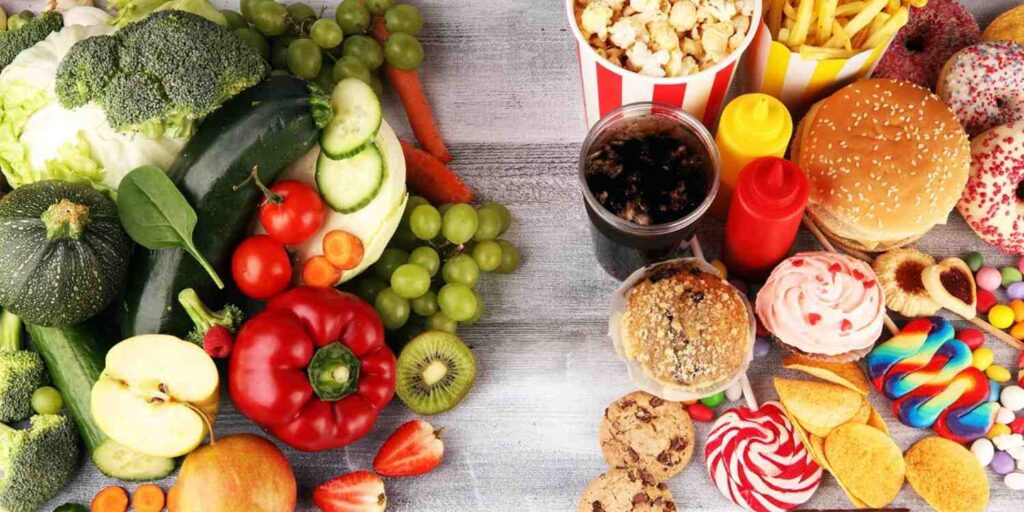
On the other end of the dietary spectrum, ultra-processed foods — defined as industrially manufactured products with multiple additives, minimal whole food content, and high caloric density — are consistently associated with worse mental health outcomes in epidemiological research. Multiple large prospective studies have found associations between higher ultra-processed food consumption and increased risk of depression and anxiety. The mechanisms are not fully established but likely involve inflammatory pathways, gut microbiome disruption, and blood sugar dysregulation — all of which have documented relationships with mood and anxiety.
Blood Sugar Stability
Blood sugar dysregulation — the pattern of spikes and crashes produced by high-glycemic diets and irregular eating — produces mood and energy fluctuations that compound mental health symptoms. Stabilizing blood sugar through regular, balanced meals with adequate protein, fat, and fiber is a foundational dietary change with direct mood implications.
What This Means for Your Care
Nutrition is not a replacement for psychiatric treatment. For significant depression, anxiety disorders, or other clinical presentations, medication and psychotherapy have far more robust evidence than dietary intervention alone. What nutrition can meaningfully do is reduce one of the modifiable contributors to mental health, support the effectiveness of other treatments, and contribute to overall physiological conditions that support mood regulation. Understanding this as part of a comprehensive approach — rather than as a cure or an alternative — is what the evidence supports. This kind of patient education is something we take seriously as part of good psychiatric care.
Frequently Asked Questions
Can changing your diet help depression?
The evidence supports diet as a meaningful contributor to depression risk and as a modifiable factor that can support treatment — not as a treatment in itself. The Mediterranean dietary pattern has the most evidence for mental health benefit. For significant depression, dietary improvement works best as a complement to evidence-based treatment rather than a replacement.
What foods are worst for mental health?
Ultra-processed foods — industrially manufactured products high in refined carbohydrates, added sugars, unhealthy fats, and additives, with minimal whole food content — are most consistently associated with worse mental health outcomes in research. High-sugar, high-glycemic diets also produce blood sugar fluctuations that worsen mood stability.
Does omega-3 help with anxiety?
Omega-3 fatty acids have evidence for reducing inflammation and supporting neurotransmitter function, with associations with reduced anxiety symptoms in several studies. Even for depression, it’s still uncertain whether omega-3 supplements help, and any effect may be small. Side effects are usually mild, but it’s worth checking with your provider before adding a supplement.
Is nutritional psychiatry a real field?
Yes — nutritional psychiatry is a legitimately developing field with its own research base, professional organizations, and clinical applications. It sits at the intersection of nutrition science and psychiatric medicine and recognizes that diet is one of several modifiable factors that influence mental health outcomes.
If you are thinking about nutrition as part of your mental health care — or if you have been wondering whether what you eat might be affecting your mood — those questions are worth bringing into your clinical care rather than navigating alone.
The science: how we checked this
Sources
- Jacka FN, et al. A randomised controlled trial of dietary improvement for adults with major depression (the 'SMILES' trial). BMC Medicine, 2017
- Firth J, et al. The Effects of Dietary Improvement on Symptoms of Depression and Anxiety: A Meta-Analysis of Randomized Controlled Trials. Psychosomatic Medicine, 2019
- Lane MM, et al. Ultra-processed food exposure and adverse health outcomes: umbrella review of epidemiological meta-analyses. BMJ, 2024
- NCCIH (National Institutes of Health): Omega-3 Supplements: What You Need To Know
How we checked this
- The SMILES trial (67 adults, 12 weeks, remission in about a third of the diet group versus 8 percent with social support): Jacka and colleagues, BMC Medicine (2017).
- Diet changes and depression or anxiety across 16 trials: Firth and colleagues, Psychosomatic Medicine (2019).
- Ultra-processed food and depression, anxiety and common mental health conditions, and the quality of that evidence: Lane and colleagues, BMJ (2024).
- Omega-3 supplements and depression, and their usual side effects: NCCIH.
- The Mediterranean pattern and diet as a complement to treatment restate this article's own explanation.
- Written in our own words from the sources above.
Live in New Jersey? Start your intake packet.


