Quick answer
For many North Jersey commuters, the hardest part of psychiatric care is finding the time, not wanting help. Secure video visits remove the commute, which makes regular follow-ups realistic, and follow-ups are where medication gets adjusted. One rule matters: you need to be physically in New Jersey during each visit, so plan visits for a remote day or a day off. Most visits are by secure video, anywhere in New Jersey. Our office is in Mount Laurel, NJ, and in-person visits there are limited and by appointment only; ask our office.
Key takeaways
- For many North Jersey commuters, the real barrier to psychiatric care is the schedule, not willingness.
- Long commutes can cut into sleep and recovery time, which can worsen mood and anxiety.
- Telehealth makes consistent follow-up realistic, and follow-up is when medication adjustments actually get made.
- Performing well at work doesn't rule out a treatable condition, especially when keeping up takes a heavy internal toll.
For adults in North Jersey commuting into Manhattan, the obstacle to psychiatric care is rarely willingness. It is arithmetic.
A twelve-hour day that includes three hours of transit does not leave room for an appointment requiring travel during business hours. North Jersey telepsychiatry addresses that specific constraint — not by changing the clinical work, but by removing the part that made it unattendable.
The Schedule Problem, Stated Plainly
An in-person psychiatric appointment during working hours typically costs a half day once travel is included. That is manageable once. It is not manageable every six weeks as an ongoing pattern, particularly for people whose work does not accommodate regular midday absences.
The consequence is predictable: people attend the initial evaluation, then attend follow-ups inconsistently, then stop. The treatment is not abandoned because it failed. It is abandoned because attending it competed with work and lost.
This matters clinically because psychiatric treatment depends on follow-up. The early weeks after starting or changing a medication are when adjustment decisions get made. Missing that window frequently means an inadequate dose is maintained indefinitely, and the person concludes the medication does not work when it was never optimized.
What the Commute Itself Does

The transit is not neutral. It has measurable effects worth naming, because they are frequently treated as background rather than as clinical contributors.
Sleep compression. Leaving at six and returning at eight shortens sleep at both ends. Chronic sleep restriction independently worsens mood, anxiety, concentration, and emotional regulation. It is one of the more common untreated contributors to psychiatric symptoms in this population.
Loss of recovery time. The hours that would otherwise absorb the day’s stress are spent in transit. For someone already managing anxiety, the absence of decompression meaningfully increases symptom load.
Constrained social contact. Relationships and social activity are protective. A schedule that leaves no time for them removes a genuine buffer.
Chronic low-grade activation. Crowding, delays, and unpredictability keep the nervous system in a mildly activated state for hours each day. This is not trauma, and it is not nothing.
Myth or fact? Commuting and your mental health
Choose an answer for each to see the explanation. Nothing is saved.
1Not getting enough sleep can affect your mood and how you handle stress.
Fact. Ongoing short sleep can make you feel frustrated, cranky or worried, make it harder to focus, and is linked to depression. A long commute can cut into sleep at both ends of the day.
2If I'm still doing well at work, there's nothing to treat.
Myth. Anxiety and depression are judged by symptoms and their impact, and that includes what it costs you inside to keep performing. Meeting every obligation while sleeping poorly and waking with dread can still be a treatable condition.
3I can do my New Jersey telehealth visit from my desk in Manhattan.
Myth. What matters is where you are during the visit. At ANK, you need to be physically in New Jersey for each visit, so many commuters plan visits for a remote day or a day off.
The Presentation That Shows Up
Adults in this population frequently present with a recognizable combination: anxiety that has been present long enough to feel like temperament, sleep restriction treated as unavoidable, and a level of functioning that has been maintained at substantial internal cost.
The defining feature is that nothing has visibly failed. Work continues. Obligations are met. Colleagues would describe the person as doing well.
That maintained functioning is exactly why the situation persists for years. Nothing collapses conspicuously enough to force the issue, and the person concludes that because they are managing, there is nothing to treat.
This reasoning is understandable and clinically inaccurate. Anxiety disorders and depression are assessed on symptoms and functional impact, and impact includes what it costs internally to keep performing. Someone meeting every obligation while sleeping five hours and waking with dread is describing a treatable condition, not a personality.
Is it this or that?
A midday office visit, or a secure video visit?
| Office visit during work hours | Secure video visit | |
|---|---|---|
| Time it takes | Often half a day once travel is included. | About the length of the visit itself. |
| When it can happen | Usually means time away from work in the middle of the day. | Can fit on a remote day or a day off, depending on the hours the practice sees patients. |
| Follow-ups | Easy to miss when they compete with work. | Easier to keep, so medication can be adjusted when it needs to be. |
| What you need | Travel and time off. | A private spot in New Jersey, a device and an internet connection. |
Office visit during work hours
- Time it takes
- Often half a day once travel is included.
- When it can happen
- Usually means time away from work in the middle of the day.
- Follow-ups
- Easy to miss when they compete with work.
- What you need
- Travel and time off.
Secure video visit
- Time it takes
- About the length of the visit itself.
- When it can happen
- Can fit on a remote day or a day off, depending on the hours the practice sees patients.
- Follow-ups
- Easier to keep, so medication can be adjusted when it needs to be.
- What you need
- A private spot in New Jersey, a device and an internet connection.
Research suggests that for many people, mental health care by video works about as well as care in person (a 2021 review of 57 studies). Most visits are by secure video, anywhere in New Jersey. Our office is in Mount Laurel, NJ, and in-person visits there are limited and by appointment only; ask our office.
What Changes With Telehealth
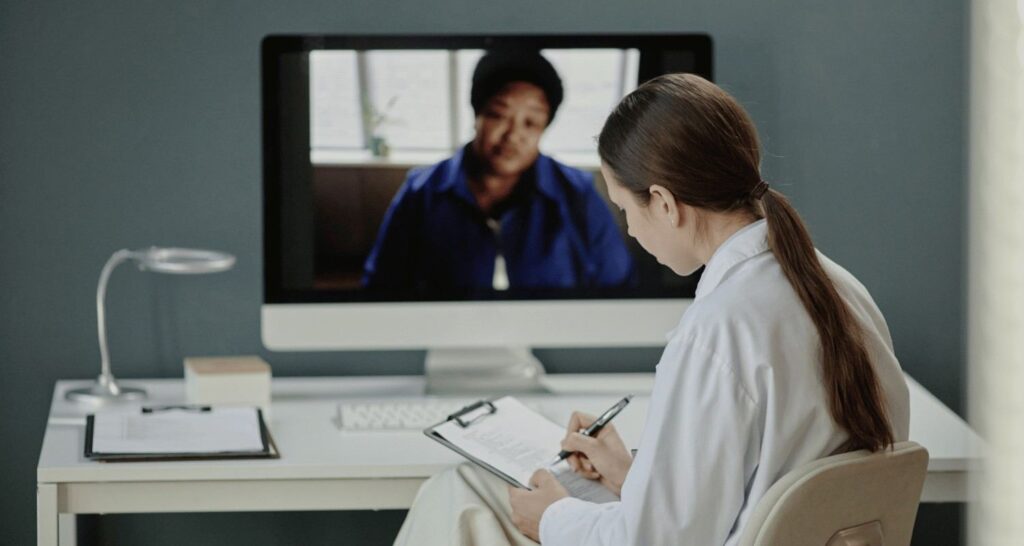
Appointments fit into your week. A remote workday or a day off works well, since you need to be in New Jersey for the visit. Follow-up visits are typically 20 to 30 minutes, and extended follow-ups are available. An appointment costs only the time of the appointment itself.
Follow-up becomes realistic. A brief check-in two weeks after a medication change stops being a logistical problem. This is the single most clinically valuable effect, because it is what allows dose optimization to actually happen.
Geography stops constraining choice. Someone in North Jersey is not limited to nearby practices. The same is true across Central Jersey mental health access and the rest of the state.
The waiting room disappears. For people with social anxiety, this removes a real barrier.
Continuity becomes achievable. The clinical value of ongoing psychiatric care comes largely from longitudinal observation — watching how symptoms shift across months and how a medication performs over time. That requires seeing the same provider repeatedly, which requires actually attending. A format that fits the schedule is what makes the pattern visible at all.
The One Constraint That Applies
Licensure follows the patient’s physical location during the appointment. A provider licensed only in New Jersey generally cannot see you while you are at a desk in Manhattan, and at ANK, you need to be physically in New Jersey for each visit.
For commuters, this means appointments generally need to happen on remote days or days off, when you’re in New Jersey. Ask what hours a practice sees patients. It is worth confirming before scheduling rather than discovering at the start of a session.
Planning around your commute
Fitting care around your commute
Tick the steps you want to take, then copy your list. Nothing is saved or sent.
Frequently Asked Questions
Can I do a telehealth appointment from my office in New York?
Not if your provider is licensed only in New Jersey. Licensure is determined by where you are physically located during the appointment, not where you live. Many commuters schedule visits on remote days or days off so they are in New Jersey at the time. Confirming this before booking avoids a cancelled session.
Can commuting really contribute to anxiety or depression?
It contributes meaningfully, primarily through sleep restriction and loss of recovery time. Chronic sleep restriction independently worsens mood, anxiety, concentration, and emotional regulation, and a long commute compresses sleep at both ends. This does not mean commuting causes psychiatric conditions, but it is a real and frequently unaddressed contributor that treatment should account for.
I am still performing well at work. Is that a reason not to seek evaluation?
No, and this is one of the more common reasons people delay for years. Anxiety and depression are assessed on symptoms and functional impact, and impact includes the internal cost of continuing to perform. Maintained external functioning alongside poor sleep, persistent dread, and constant tension is a recognized presentation rather than evidence that nothing is wrong.
How do I fit psychiatric follow-up around a demanding schedule?
Ask what hours a practice sees patients and confirm typical follow-up intervals before starting. New Jersey’s earned sick leave can be used for medical appointments, including mental health care. Telehealth removes travel entirely, which is generally what makes consistent follow-up realistic. Consistency matters more than most people expect — the weeks following a medication change are when the adjustments that determine whether treatment works actually get made.
If psychiatric care has previously fallen apart because attending it competed with your schedule, that is a logistical problem rather than a treatment failure, and it is solvable.
This article is for general educational purposes only. It does not constitute medical advice, does not establish a provider-patient relationship, and is not a substitute for individual evaluation, diagnosis, or treatment by a qualified clinician. If you’re in crisis or thinking about harming yourself, call or text 988 (Suicide & Crisis Lifeline), any time, day or night. In an emergency, call 911 or go to the nearest emergency room.
The science: how we checked this
Sources
- National Institute of Mental Health: Getting Mental Health Support Virtually
- Batastini AB, et al. Are videoconferenced mental and behavioral health services just as good as in-person? A meta-analysis. Clinical Psychology Review, 2021
- National Heart, Lung, and Blood Institute (NIH): Sleep Deprivation and Deficiency, health effects
- New Jersey Department of Labor: Earned Sick Leave
How we checked this
- Telehealth being effective for conditions such as anxiety and depression, not needing travel, and needing a device, an internet connection, privacy and insurance that covers it: NIMH, Getting Mental Health Support Virtually.
- Video care giving results largely similar to in-person care, and the need for more trials: Batastini and colleagues' review of 57 studies (2021).
- Short sleep and feeling frustrated, cranky or worried, trouble focusing, and the link with depression: NHLBI.
- The second myth card, the comparison and the checklist also sum up this article's own explanation and advice.
- Seeing patients only while they're physically in New Jersey, and visit format, are ANK's own policy and wording.
- Earned sick leave being usable for your own physical or mental illness: New Jersey Department of Labor, Earned Sick Leave.
- Written in our own words from the sources above.
Live in New Jersey? Start your intake packet.


