
Quick answer
Your gut and brain are in constant two-way contact, through nerves such as the vagus nerve, hormones and the immune system, and the microbes living in your gut appear to play a part. That link is real, but research on using it to treat anxiety or depression is still early. Small studies of probiotics and diet changes suggest modest benefits for depression at best, and they don't replace treatment. If you have ongoing stomach or bowel problems along with mood or anxiety symptoms, mention both to your providers.
Key takeaways
- Your gut and brain are in constant two-way communication, including through the vagus nerve.
- Diets high in vegetables, fiber and minimally processed foods are associated with better mental health.
- Evidence for probiotics and diet changes as treatments for depression or anxiety is still emerging, and they don't replace treatment.
- If you have ongoing digestive problems along with mood or anxiety symptoms, it helps to mention both to your providers.
The relationship between the gut and the brain is significantly more substantial than most people realize — and significantly more nuanced than the popular wellness conversation about it tends to suggest.
This does not mean that mental health conditions are primarily gut disorders, or that changing your diet will cure anxiety or depression. What it means is that the gut-brain connection is real, bidirectional, and clinically relevant — and that understanding it changes how we think about both mental and physical health.
The Gut-Brain Axis
The gut contains an extensive network of neurons — the enteric nervous system — that communicates bidirectionally with the brain through multiple pathways, including the vagus nerve. This communication is not incidental. It is one of the primary channels through which the body’s state is registered by the brain, and through which the brain’s state affects the body.
Research available through the National Institutes of Health has documented that the gut-brain axis involves neural, endocrine, and immune signaling pathways that connect the state of the gastrointestinal environment to brain function, stress response, and mood regulation. This is not a fringe area of research. It is a recognized and actively studied dimension of the neuroscience of mental health.
Is it this or that?
What we know, and what's still early
| What research shows | What's still uncertain | |
|---|---|---|
| The gut-brain link | The gut and brain communicate in both directions, through nerves (including the vagus nerve), hormones, the immune system and substances made by gut microbes. | Much of what we know about gut microbes and behavior comes from animal studies. Studies in people are ongoing. |
| Probiotics | A 2025 review of small trials found probiotics may modestly ease depressive symptoms in some adults with mild to moderate depression. | The trials were small and some were industry-funded; without those, the effect was no longer clear. Probiotics aren't a replacement for depression treatment. |
| Diet | A review of 16 trials found that improving diet modestly reduced depressive symptoms, mostly in people without diagnosed depression. | Those trials found no clear effect on anxiety, and which parts of a diet matter most is still unknown. |
| IBS and mental health | Depression and anxiety are more common in people with irritable bowel syndrome (IBS), which involves problems with how the brain and gut work together. | Researchers think these problems may play a role in causing IBS, but the details aren't fully understood. |
What research shows
- The gut-brain link
- The gut and brain communicate in both directions, through nerves (including the vagus nerve), hormones, the immune system and substances made by gut microbes.
- Probiotics
- A 2025 review of small trials found probiotics may modestly ease depressive symptoms in some adults with mild to moderate depression.
- Diet
- A review of 16 trials found that improving diet modestly reduced depressive symptoms, mostly in people without diagnosed depression.
- IBS and mental health
- Depression and anxiety are more common in people with irritable bowel syndrome (IBS), which involves problems with how the brain and gut work together.
What's still uncertain
- The gut-brain link
- Much of what we know about gut microbes and behavior comes from animal studies. Studies in people are ongoing.
- Probiotics
- The trials were small and some were industry-funded; without those, the effect was no longer clear. Probiotics aren't a replacement for depression treatment.
- Diet
- Those trials found no clear effect on anxiety, and which parts of a diet matter most is still unknown.
- IBS and mental health
- Researchers think these problems may play a role in causing IBS, but the details aren't fully understood.
General information, not medical advice. Ask your provider before starting a supplement, especially if you take other medications.
The Gut Microbiome and Mental Health
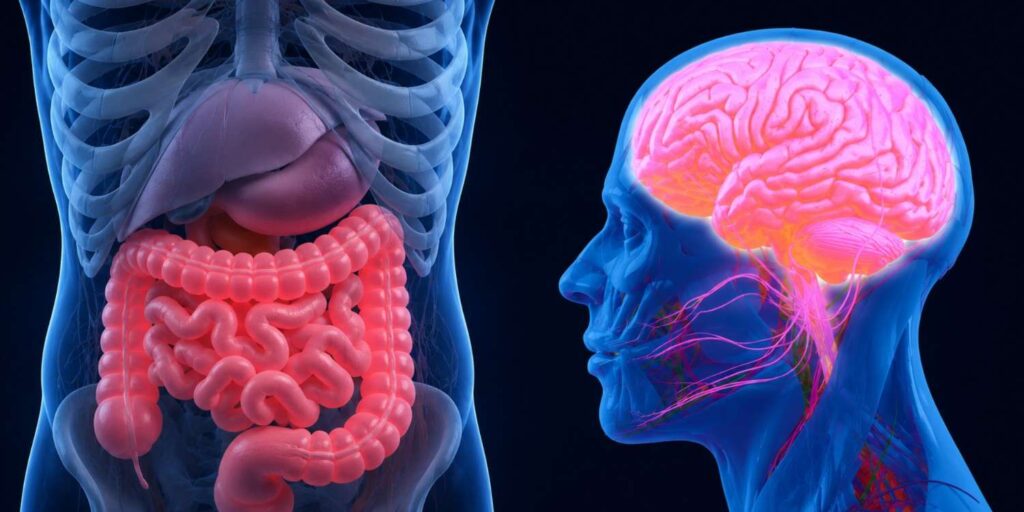
The gut hosts trillions of microorganisms — bacteria, fungi, and other microbes — collectively called the microbiome. The microbiome produces substances, such as short-chain fatty acids, that research suggests can influence the brain through the immune system, the vagus nerve and other pathways.
One well-known fact about gut biology is that the gut hosts the vast majority of the body’s serotonin-producing cells. It is important to understand, however, that this gut-derived serotonin does not cross the blood-brain barrier and does not directly contribute to brain serotonin levels or mood regulation. The central and peripheral serotonin systems are anatomically separate. Instead, the gut microbiome influences brain function through other pathways: effects on tryptophan availability, immune signaling, communication through the vagus nerve, and production of short-chain fatty acids and other metabolites that affect nervous system function. Researchers describe the microbiota-gut-brain axis as a growing area of mental health research.
What the Evidence Currently Supports
The research in this area is still developing, and it is worth being honest about the current state of evidence. The gut-brain connection is well-established. The clinical applications — specific probiotics, dietary interventions, microbiome modifications — are less well-established. Promising associations exist, but robust evidence for specific interventions is still emerging.
This means that gut health is genuinely relevant to mental health — but it does not mean that probiotic supplements are an evidence-based treatment for depression, or that dietary change alone is sufficient treatment for anxiety disorders.
Myth or fact? Your gut and your mood
Choose an answer for each to see the explanation. Nothing is saved.
1Probiotics are a proven treatment for depression.
Myth. Some small trials suggest a modest benefit, but the researchers say the results should be read with caution and larger, independent trials are needed. Probiotics may support care, but they don't replace treatment.
2Changing your diet can cure anxiety or depression.
Myth. In a review of 16 trials, improving diet modestly reduced depressive symptoms but had no clear effect on anxiety. A good diet can support your health; it isn't a cure on its own.
3Irritable bowel syndrome (IBS) and anxiety often go together.
Fact. Anxiety and depression are more common in people with IBS. Mental health approaches such as cognitive behavioral therapy, gut-directed hypnotherapy and relaxation training can help improve IBS symptoms.
Practical Implications

For most people, the practical implications of the gut-brain connection come down to a few consistent themes. Diets high in vegetables, fiber, and minimally processed foods have associations with better mental health, and improving diet has modestly reduced depressive symptoms in trials. Chronic GI disruption and psychiatric symptoms frequently co-occur and warrant integrated attention. And the bidirectional relationship between gut and brain means that addressing mental health can improve GI symptoms, and addressing GI health can support mental wellbeing.
These are not dramatic interventions. But they reflect an understanding that physical health and mental health are integrated rather than separate — and that attending to both is part of comprehensive care. A comprehensive psychiatric evaluation that takes the full picture seriously — including physical health factors that affect mental health — is more likely to identify what is actually contributing to a presentation and what comprehensive support looks like.
Frequently Asked Questions
Does the gut really affect mental health?
Yes — the gut-brain connection is well-established and bidirectional. The gut contains its own nervous system, communicates with the brain through the vagus nerve, and produces substances including neurotransmitter precursors that affect brain function. Disruptions in this communication are associated with both GI conditions and psychiatric conditions.
Can fixing gut health improve depression or anxiety?
The gut-brain connection is real, but the clinical evidence for specific dietary or probiotic interventions as treatments for depression or anxiety is still emerging. General dietary patterns that reduce inflammation are associated with better mental health outcomes, but targeted gut interventions are not currently evidence-based treatments for mood or anxiety disorders on their own. They may support treatment, but they do not replace it.
Is irritable bowel syndrome related to anxiety?
Yes — IBS and anxiety have well-documented bidirectional relationships. Anxiety activates the sympathetic nervous system, which directly disrupts GI function. GI symptoms produced by anxiety can then increase anxiety. Anxiety and depression are more common in people with IBS, and mental health therapies such as cognitive behavioral therapy can help improve IBS symptoms.
Can diet affect mental health?
General dietary patterns have meaningful associations with mental health outcomes. Diets rich in vegetables, fiber, and minimally processed foods are associated with better mental health, and a review of 16 trials found that improving diet modestly reduced symptoms of depression, though not anxiety. This does not establish direct causation or support specific dietary prescriptions, but it reflects the integration between physical and mental health that the gut-brain connection represents.
If you are managing mental health symptoms and wondering about the role that physical health — including gut health — plays, that question deserves integrated attention in your care, not dismissal.
The science: how we checked this
Sources
- Cryan JF, et al. The Microbiota-Gut-Brain Axis. Physiological Reviews, 2019
- Firth J, et al. The Effects of Dietary Improvement on Symptoms of Depression and Anxiety: A Meta-Analysis of Randomized Controlled Trials. Psychosomatic Medicine, 2019
- Efficacy of probiotic intervention in unmedicated depression: a systematic review and meta-analysis. Frontiers in Psychiatry, 2025
- NIDDK: Symptoms and Causes of Irritable Bowel Syndrome
- NIDDK: Treatment for Irritable Bowel Syndrome
How we checked this
- How the gut and brain communicate (immune system, vagus nerve, enteric nervous system, microbial substances such as short-chain fatty acids) and the reliance on animal studies: Cryan and colleagues, Physiological Reviews (2019).
- Diet and depression or anxiety (16 trials, modest effect on depression, none clear on anxiety): Firth and colleagues, Psychosomatic Medicine (2019).
- Probiotics and depression (small effect, possible industry bias, findings to be read with caution): the 2025 review in Frontiers in Psychiatry.
- IBS, brain-gut interaction, anxiety and depression, and mental health therapies for IBS: NIDDK.
- Asking your provider before starting a supplement is general safety advice.
- Written in our own words from the sources above.
Live in New Jersey? Start your intake packet.


