
Quick answer
Stress that goes on for weeks or months can change how parts of the brain work. In research, the hippocampus (memory and context) and the prefrontal cortex (calming and control) tend to pull back, while the amygdala (threat detection) tends to become more reactive. Many of these changes appear to be reversible, and effective treatment and regular exercise have both been linked with changes in the right direction.
Key takeaways
- Stress that goes on for weeks or months can affect how parts of the brain work, and in some areas, its structure.
- Under chronic stress, memory and calming regions tend to pull back, while the brain's threat-detection system tends to become more reactive.
- These changes help explain some symptoms of anxiety and depression, and many of them appear to be reversible.
- Effective treatment and regular exercise have both been linked with brain changes in the right direction.
Chronic stress does not only affect how you feel. Research suggests it can also affect how the brain works, and in some areas its structure. Those findings help explain some symptoms of anxiety and depression, and why treatment for them can help.
The changes are real. Many of them also appear to be reversible. And understanding them changes how these conditions make sense.
The Hippocampus: Memory, Context, and Stress
The hippocampus is a region involved in forming and retrieving memories, regulating the stress response, and providing contextual information to the brain’s threat-detection system. Long-lasting stress, and stress hormones such as cortisol, can affect how the hippocampus works and, in animal studies, its structure.
Large brain-imaging studies have found that, on average, people with PTSD and people with recurrent depression have a slightly smaller hippocampus than people without these conditions. The difference is small and is an average, not something seen in everyone. Researchers think stress hormones may play a part, based largely on animal research. A hippocampus under strain may have a harder time putting threat in context, that is, recognizing that a situation is safe now even if it resembles something that was dangerous before. That may help explain the triggers seen in PTSD, and how anxiety can spread to more and more situations.
Importantly, these changes do not appear to be fixed. In animal studies, stress-related changes in the hippocampus are largely reversible. In one small study of people with PTSD, 9 to 12 months of treatment with the antidepressant paroxetine was linked with better memory and a larger hippocampus. In a randomized trial in older adults, aerobic exercise increased the size of the hippocampus. The brain keeps a real capacity to change and adapt, called neuroplasticity, and effective treatment of depression works with that capacity.
Myth or fact? Stress and the brain
Choose an answer for each to see the explanation. Nothing is saved.
1Stress hormones are always bad for your brain.
Myth. In the short term, stress hormones help: they make the brain more alert and help you handle a challenge. The problem is stress that goes on for weeks or months, when the body stays on alert even though there's no danger.
2Everyone with PTSD or depression has a smaller hippocampus.
Myth. Large brain-imaging studies found a slightly smaller hippocampus on average in people with PTSD and in people with recurrent depression. The difference is small and is an average. In the depression study, people having their first episode didn't differ from people without depression.
3Exercise can change the size of the hippocampus.
Fact. In a randomized trial of 120 older adults, aerobic exercise training increased the size of the front part of the hippocampus, along with better memory on a spatial test.
The Amygdala: Threat Detection and Fear Learning
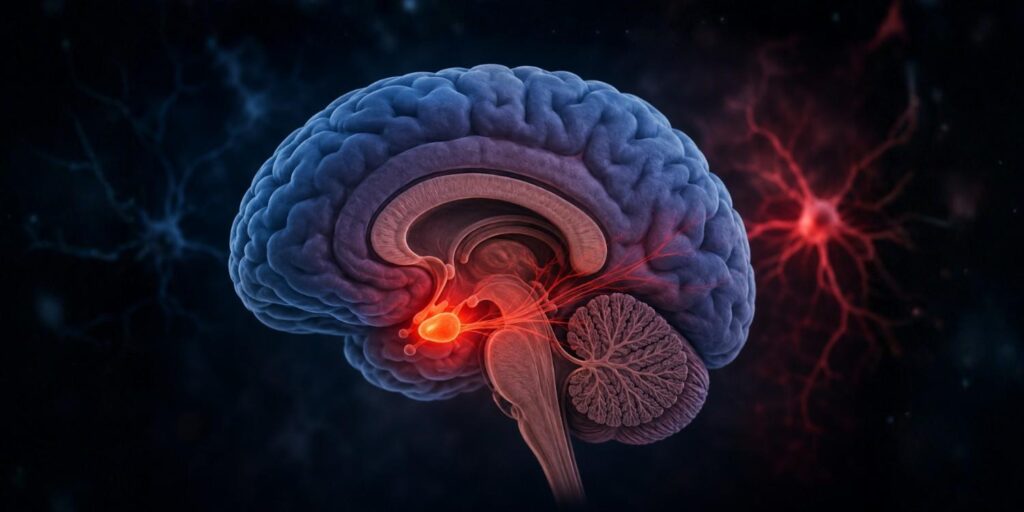
The amygdala is a region involved in threat detection, fear learning, and the generation of emotional responses, particularly fear and anxiety. Chronic stress affects the amygdala differently from the hippocampus. In animal studies, some amygdala nerve cells grow more branches under chronic stress rather than fewer.
While parts of the hippocampus tend to pull back under chronic stress, the amygdala tends to become more reactive. Studies of people with PTSD have found increased amygdala activity. A more reactive amygdala may switch on faster, more strongly, and in response to more ambiguous situations. This is thought to contribute to the hypervigilance, strong startle response and quickness to fear that often come with chronic anxiety and PTSD.
The Prefrontal Cortex: Regulation and Executive Function
The prefrontal cortex — particularly the medial and lateral prefrontal regions — provides top-down regulation of the amygdala’s emotional responses. It is involved in cognitive reappraisal, decision-making, working memory, and the inhibitory control that prevents reactive responses from immediately translating into behavior.
Chronic stress can weaken prefrontal function. In animal studies, nerve cells in the medial prefrontal cortex lose branches and shrink under chronic stress, and studies of people with PTSD have found reduced medial prefrontal activity. The likely effect is a nervous system that produces stronger threat responses (amygdala) and has less ability to calm them (prefrontal cortex).
This pattern — a more reactive amygdala combined with a less effective prefrontal cortex — is one way researchers understand chronic anxiety. It suggests anxiety is not just about thoughts and worries but also about a nervous system that stress has recalibrated. It may also help explain why burnout and chronic stress can feel so similar to anxiety and depression.
Is it this or that?
Three brain regions under chronic stress
| Hippocampus | Amygdala | Prefrontal cortex | |
|---|---|---|---|
| What it does | Forms memories and helps the brain tell when a situation is safe now. | Spots threats, learns fear and produces fear and anxiety. | Calms the amygdala's responses and handles decisions, working memory and impulse control. |
| Under chronic stress (animal studies) | Some nerve cells lose branches, and fewer new nerve cells form. | Some nerve cells grow more branches. | Nerve cells in the middle (medial) part lose branches. |
| In people | Slightly smaller on average in PTSD and recurrent depression. | More active in PTSD and some other anxiety disorders. | Part of it is less active in PTSD. |
Hippocampus
- What it does
- Forms memories and helps the brain tell when a situation is safe now.
- Under chronic stress (animal studies)
- Some nerve cells lose branches, and fewer new nerve cells form.
- In people
- Slightly smaller on average in PTSD and recurrent depression.
Amygdala
- What it does
- Spots threats, learns fear and produces fear and anxiety.
- Under chronic stress (animal studies)
- Some nerve cells grow more branches.
- In people
- More active in PTSD and some other anxiety disorders.
Prefrontal cortex
- What it does
- Calms the amygdala's responses and handles decisions, working memory and impulse control.
- Under chronic stress (animal studies)
- Nerve cells in the middle (medial) part lose branches.
- In people
- Part of it is less active in PTSD.
In animal studies, many of these changes are largely reversible once the stress ends, though less readily in older animals. In people, findings are averages across groups, not something a scan can show in one person.
The Good News: Neuroplasticity

The most important takeaway from this research is that the brain’s changes are not necessarily permanent. Neuroplasticity — the brain’s capacity to change its structure and function in response to experience — works in both directions. In animal studies, antidepressants increase the growth of new nerve cells in the hippocampus. In a small study of people with PTSD, successful antidepressant treatment was linked with a larger hippocampus. Exercise has been shown to increase hippocampal size in older adults, along with higher levels of BDNF, a protein that supports the growth of new nerve cells.
Frequently Asked Questions
Does stress actually shrink the brain?
Large imaging studies have found a slightly smaller hippocampus, on average, in people with PTSD and in people with recurrent depression. Researchers think long-term exposure to stress hormones such as cortisol plays a part, based mostly on animal research. This is not necessarily permanent: effective treatment and exercise have both been linked with changes in the hippocampus in the right direction.
What does cortisol do to the brain?
Cortisol is one of the body’s main stress hormones. In short bursts, stress hormones are useful: they make the brain more alert and help you handle a challenge. When stress goes on for weeks or months, the body stays on alert even without danger, and over time that can harm your health. In animal studies, long-term high levels of stress hormones change nerve cells in the hippocampus and prefrontal cortex. Chronic stress is also linked with a more reactive amygdala and weaker prefrontal control.
Is brain damage from stress permanent?
The term ‘damage’ can be misleading — the changes are better understood as adaptations, and research suggests many of them are reversible. Effective treatment for depression and anxiety, along with regular exercise, works with the brain’s ability to change and may support recovery.
Can anxiety cause permanent brain changes?
Chronic anxiety and stress are linked with changes in how the amygdala, hippocampus and prefrontal cortex work together, and those changes affect symptoms and day-to-day functioning. Research suggests many of them can improve with effective treatment. That is one more reason not to wait: getting help sooner means less time living with symptoms.
If you have been living with chronic stress, anxiety, or depression — and wondering what it has been doing to you over time — the answer is both honest and genuinely hopeful. The brain changes. And it can change back.
The science: how we checked this
Sources
- MedlinePlus: Stress and your health
- McEwen BS et al. Stress effects on neuronal structure: hippocampus, amygdala, and prefrontal cortex. Neuropsychopharmacology, 2016
- McEwen BS. Neurobiological and systemic effects of chronic stress. Chronic Stress, 2017
- Logue MW et al. Smaller hippocampal volume in PTSD: a multisite ENIGMA-PGC study. Biological Psychiatry, 2018
- Schmaal L et al. Subcortical brain alterations in major depressive disorder: ENIGMA. Molecular Psychiatry, 2016
- Etkin A, Wager TD. Functional neuroimaging of anxiety: a meta-analysis. American Journal of Psychiatry, 2007
- Erickson KI et al. Exercise training increases size of hippocampus and improves memory. PNAS, 2011
How we checked this
- Short-term stress hormones helping, and chronic stress keeping the body on alert: MedlinePlus.
- What chronic stress does to nerve cells in animal studies, and how reversible it is: the two McEwen reviews (2016 and 2017).
- A slightly smaller hippocampus on average in PTSD and in recurrent depression, and no difference in a first episode of depression: the two ENIGMA studies.
- More amygdala activity in PTSD and other anxiety disorders, and less activity in part of the prefrontal cortex in PTSD: Etkin and Wager (2007).
- Exercise and the size of the hippocampus: Erickson et al. (2011), a randomized trial in older adults.
- Written in our own words from the sources above.
Live in New Jersey? Start your intake packet.


