
Quick answer
For a telehealth visit, what matters is where you are physically during the appointment, not where you live or where the practice is based. Your provider has to be licensed or otherwise allowed to practice in that state. Some states have exceptions, such as licensure compacts, temporary practice rules or telehealth registration, so it's worth asking. At ANK, you need to be physically in New Jersey for each visit.
Key takeaways
- For telehealth, what matters is where you are physically during the appointment, not where you live or where the practice is based.
- Your provider needs to be licensed or otherwise permitted to practice in the state where you are at the time of the visit.
- Most pandemic-era cross-state waivers have expired, so it's worth confirming that an arrangement started then is still permitted.
- Planning around licensing early, such as before college or regular travel, helps prevent medication gaps and interruptions in care.
Telehealth licensure produces more confusion than almost any other practical aspect of psychiatric care. The confusion is understandable, because the rule is counterintuitive. The rule is this: the provider must be licensed in the state where the patient is physically located at the time of the appointment. Not where the patient lives. Not where the practice is based. Where the patient’s body is during the session.
Nearly every complication people encounter with telehealth psychiatry in NJ follows from that single principle.
Why the Rule Works This Way
Medical licensure is regulated at the state level, and the legal premise is that care is delivered where the patient receives it. A provider treating someone located in Pennsylvania is practicing medicine in Pennsylvania, regardless of where the provider is sitting.
This is not a telehealth-specific invention. It is the pre-existing structure of medical licensure applied to a format that made crossing state lines trivially easy.
What This Means in Practice

Living in one state and working in another. This is the most common scenario in the Greater Philadelphia and South Jersey corridor. A New Jersey resident who works in Philadelphia cannot be seen by a New Jersey-only provider while at their Philadelphia office. Appointments need to occur while they are in New Jersey.
Traveling. Being an established patient generally does not permit appointments from another state. Some states have temporary practice rules for existing patients, but they vary, so ask before you travel.
Students. Someone who grew up in New Jersey and attends college elsewhere generally cannot continue with their New Jersey provider while at school, unless that provider is licensed in the school’s state.
Split residences. People who divide time between states need a provider licensed in both, or separate providers.
Moving. Relocating permanently generally means transferring care, which is worth planning before the move rather than after.
Check your understanding
Three quick questions
1For a telehealth visit, which state's license matters?
The visit counts as care delivered where you are at the time. Not where you live, and not where the practice is based.
2You live in New Jersey and work in Philadelphia. Your provider is licensed only in New Jersey. When can you have your video visit?
Being a New Jersey resident isn't enough. Appointments need to happen while you are in New Jersey.
3Does licensure limit which conditions a telehealth provider can treat?
Licensure governs where you are, not what can be treated. Any limit on the conditions a practice treats is that practice's own decision, so it's worth asking directly.
What Happened After the Pandemic Waivers
During the COVID-19 public health emergency, many states temporarily waived cross-state licensure requirements. Those waivers were emergency measures, and most have expired. This produced a specific and common problem: people who established care during that period, sometimes across state lines, later found the arrangement no longer permissible. If your care began during that window and involves a provider in another state, it is worth confirming the current arrangement is compliant rather than assuming continuity.
Some states have since adopted licensure compacts or special telehealth registration pathways that ease cross-state practice. These vary by state and by profession, and they are worth asking about rather than assuming in either direction.
What Is Not Restricted
Several things people worry about are not actually limited by licensure.
Crisis services. The 988 Suicide and Crisis Lifeline operates nationally and is available regardless of where you are.
Emergency care. Emergency departments treat anyone who presents, anywhere.
Where the provider is. A New Jersey-licensed provider can see a New Jersey-located patient while the provider is elsewhere, subject to their own practice arrangements. The constraint is on the patient’s location.
Which conditions can be treated. Licensure governs geography, not scope. A telehealth psychiatrist for anxiety in NJ can also manage depression, bipolar disorder, OCD, PTSD, and complex presentations — the same range handled in person. Any limitation on what a practice treats is a practice decision rather than a licensure one, which is worth clarifying directly when it comes up.
Myth or fact? Telehealth across state lines
Choose an answer for each to see the explanation. Nothing is saved.
1If my provider is part of a licensure compact, they can see me in any state.
Myth. Compacts let participating providers practice in the other states that have joined that compact. Not every state belongs, each profession has its own compact, and a provider's participation is voluntary.
2Some states have rules that let a provider keep seeing an existing patient who is temporarily in that state, such as a college student.
Fact. Some states have temporary practice laws to support existing provider and patient relationships, and some have other exceptions. The rules vary a lot, so ask rather than assume. At ANK, you need to be physically in New Jersey for each visit.
3If I need urgent help while I'm out of state, my location doesn't stop me from getting it.
Fact. Crisis lines and emergency care aren't limited by your provider's license. If you're in crisis or thinking about harming yourself, call or text 988 (Suicide & Crisis Lifeline), any time, day or night. In an emergency, call 911 or go to the nearest emergency room.
Practical Questions Worth Asking
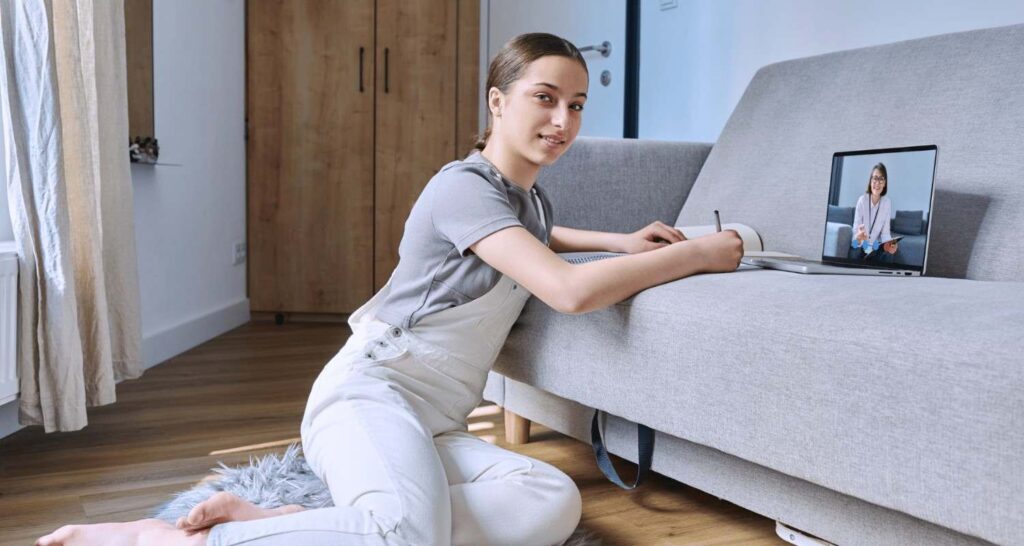
Before establishing care, it is reasonable to ask which states a provider is licensed in, what the policy is if you travel, and what happens if you move. These are ordinary administrative questions, and a practice should be able to answer them clearly.
If your circumstances involve regular cross-state presence, that is worth raising before the first appointment rather than after, since it may determine whether a given practice is workable at all.
Before your first visit
Questions to ask a telehealth provider
Tick the questions you want to ask, then copy your list. Nothing is saved or sent.
Why This Matters Clinically, Not Just Administratively
The reason to resolve this early is continuity. Psychiatric treatment depends on longitudinal observation — the same provider seeing how symptoms and treatment response change over months. Discovering a licensure problem partway through means an interruption, and interruptions in psychiatric care carry real costs: medication gaps, lost history, and the need to rebuild a clinical relationship from the beginning.
Planning around licensure at the outset is considerably less disruptive than discovering the constraint six months in.
Frequently Asked Questions
Does my psychiatrist need to be licensed where I live or where I am?
Where you are physically located at the time of the appointment. This is the rule that generates most confusion. Living in New Jersey does not permit a New Jersey-licensed provider to see you while you are sitting in another state. If you regularly spend time in more than one state, you need a provider licensed in each, or you need to schedule appointments for periods when you are in the state where your provider holds licensure.
Can I keep my psychiatrist if I go to college out of state?
Generally not, unless that provider is licensed in the state where your school is located. Many students maintain care during breaks at home and establish care with a campus or local provider during the academic year. Planning this before the semester begins helps prevent medication gaps, a common problem when the issue is discovered late.
Are the pandemic telehealth rules still in effect?
Most of the emergency cross-state licensure waivers issued during the COVID-19 public health emergency have expired. Some states have since created licensure compacts or telehealth registration pathways, but these vary by state and profession. If your care was established across state lines during that period, it is worth confirming the current arrangement is still permissible.
What do I do if I need help while out of state?
If you’re in crisis or thinking about harming yourself, call or text 988 (Suicide & Crisis Lifeline), any time, day or night. In an emergency, call 911 or go to the nearest emergency room. Neither is restricted by your provider’s license. For non-urgent needs, urgent care or a local provider can address immediate problems, and your regular prescriber can generally coordinate once you return. Carrying a current medication list makes any of these interactions considerably easier.
If your life regularly spans more than one state, resolving the licensure question before starting care prevents the interruption that otherwise tends to arrive months in.
This article is for general educational purposes only. It does not constitute medical advice, does not establish a provider-patient relationship, and is not a substitute for individual evaluation, diagnosis, or treatment by a qualified clinician. If you’re in crisis or thinking about harming yourself, call or text 988 (Suicide & Crisis Lifeline), any time, day or night. In an emergency, call 911 or go to the nearest emergency room.
The science: how we checked this
Sources
- Telehealth.HHS.gov: Getting started with licensure
- Telehealth.HHS.gov: Licensing across state lines
- Telehealth.HHS.gov: Licensure compacts
How we checked this
- Providers being licensed or legally permitted to practice in the state where the patient is located: Telehealth.HHS.gov, Getting started with licensure.
- Temporary practice laws, reciprocity, telehealth registration and other exceptions: Telehealth.HHS.gov, Licensing across state lines.
- How compacts work, and providers' participation being voluntary: Telehealth.HHS.gov, Licensure compacts.
- The quiz answers, the crisis card and the question list sum up this article's own explanation.
- Seeing patients only while they're physically in New Jersey is ANK's own policy.
- Written in our own words from the sources above.
Live in New Jersey? Start your intake packet.

Clinically reviewed by
Alyssa Killion, MSN, APN, PMHNP-BC
Board-certified psychiatric mental health nurse practitioner and founder of ANK Behavioral Health, providing telehealth psychiatric care to adults across New Jersey.
Written by ANK Behavioral Health. Reviewed on October 26, 2026.